
方向二:Data-Driven Design
1. Evolutionary De-homogenization Framework
This research develops data-driven multifidelity design methods for complex solid-porous structures. Compact low-fidelity control fields are transformed into precise and manufacturable geometries through de-homogenization, while high-fidelity simulations evaluate local stress and structural performance. Evolutionary optimization and generative models are then used to explore the design space, improve candidate diversity, and connect optimized results with CAD-compatible geometric representations.
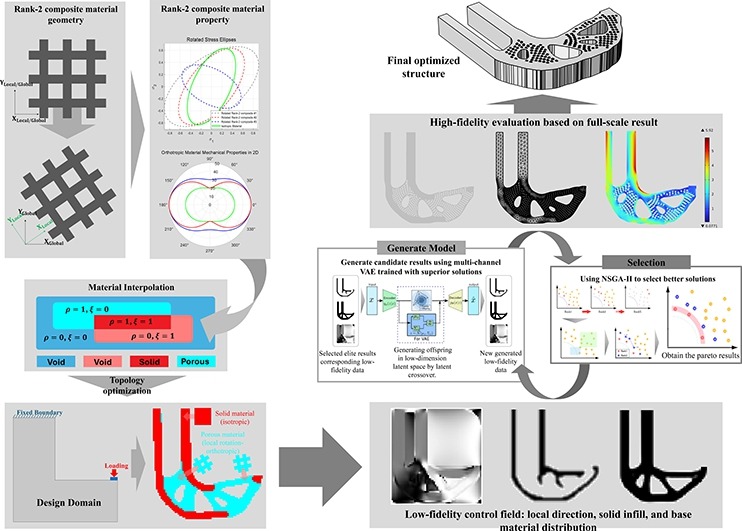
1.1. Projection-Based Evolutionary De-homogenization 专攻方向
Data-driven multifidelity optimization of hybrid solid-porous infill structures using projection-based geometric mapping, high-fidelity stress analysis, evolutionary selection, and generative candidate design.
Project Page →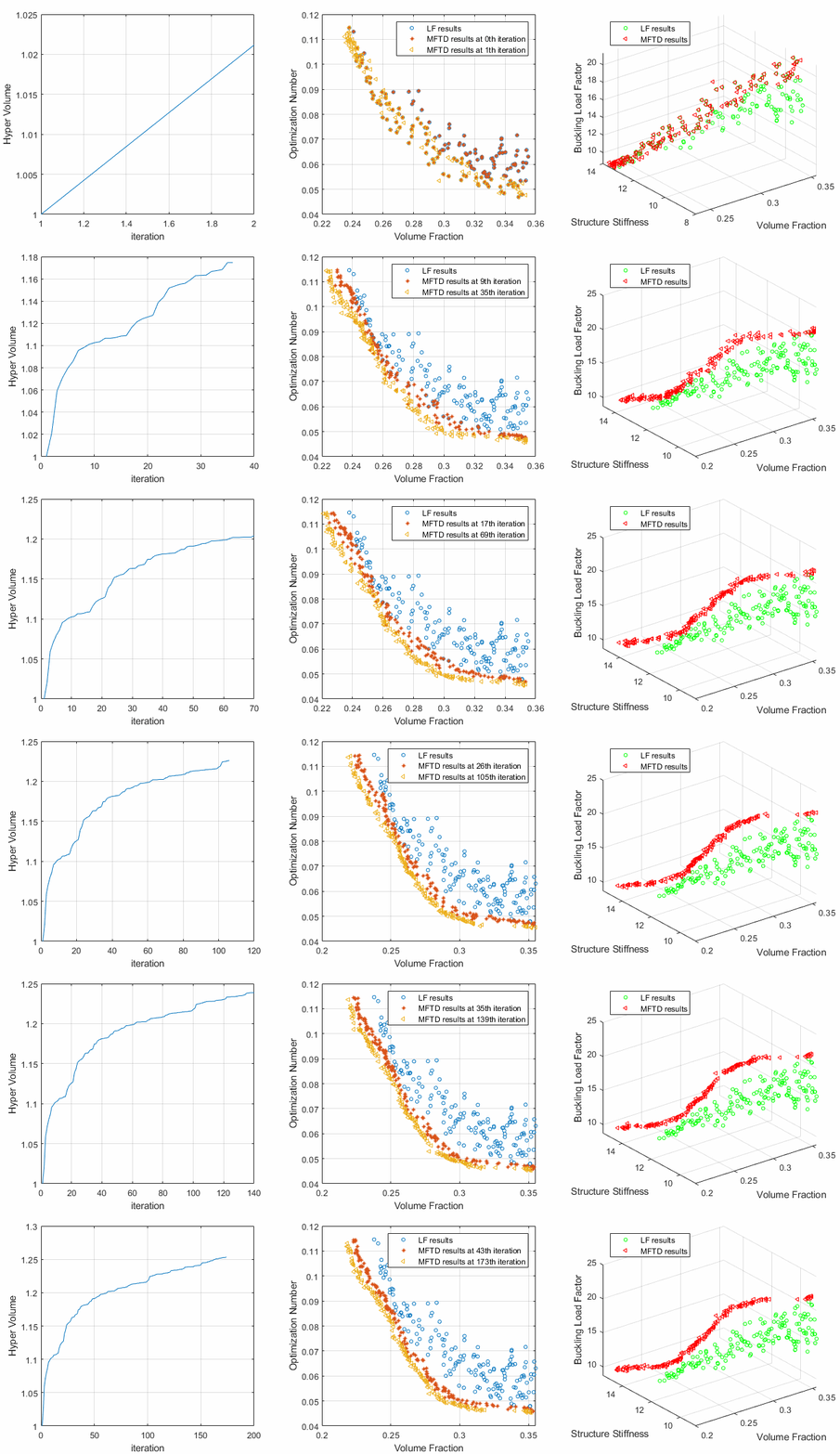
1.2. Phasor-Based Evolutionary De-homogenization 专攻方向
Phasor and wave-function representations generate spatially oriented, coherent porous patterns from optimized control fields while retaining geometric continuity and manufacturable feature control.
Project Page →