
Topology optimization for LPBF
1.Research Background
2.LPBF Simulation Solver
2.1.Thermal-Elastic-Plastic Solver
Detail coming soon…
2.2.Thermal Solver (Overheating Prediction)
Detail coming soon…
2.3.Simplified Solver based on Inherent Strain Method
2.3.1.Solver framework
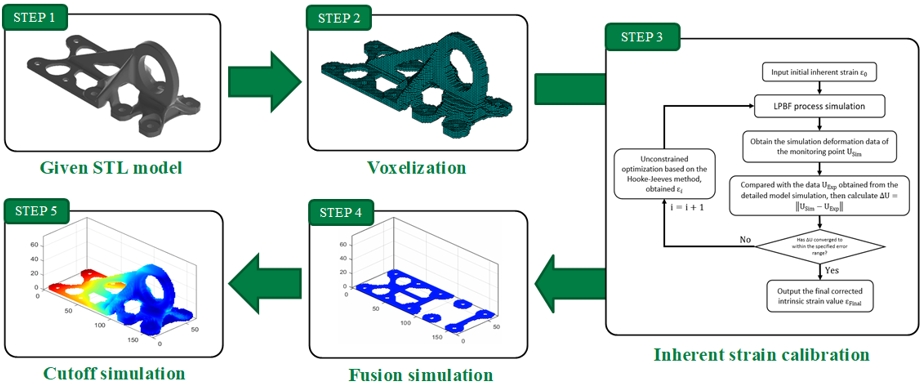
Simulation flow chart based on inherent strain method.
2.3.2.Simulation process
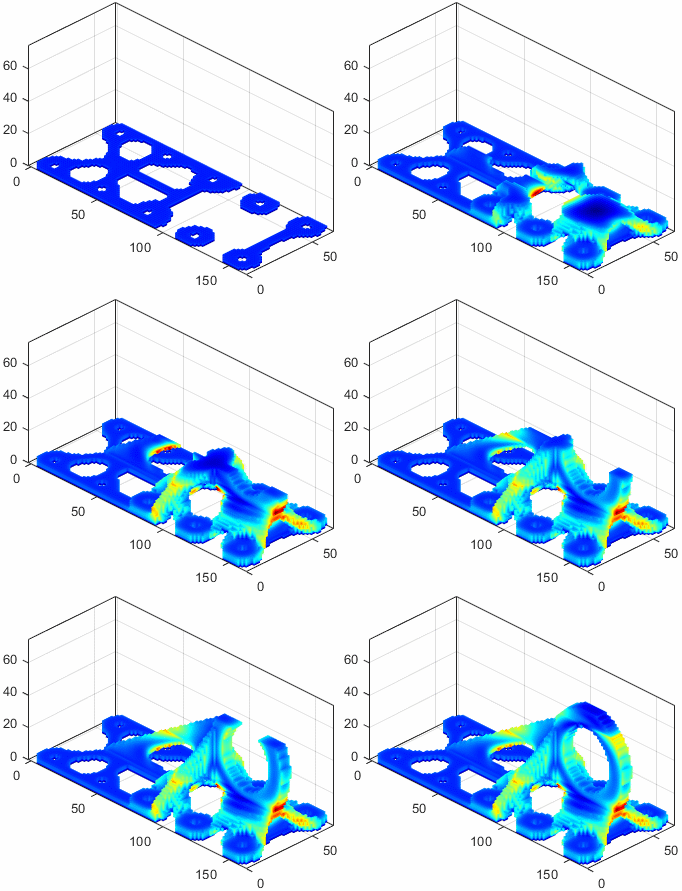
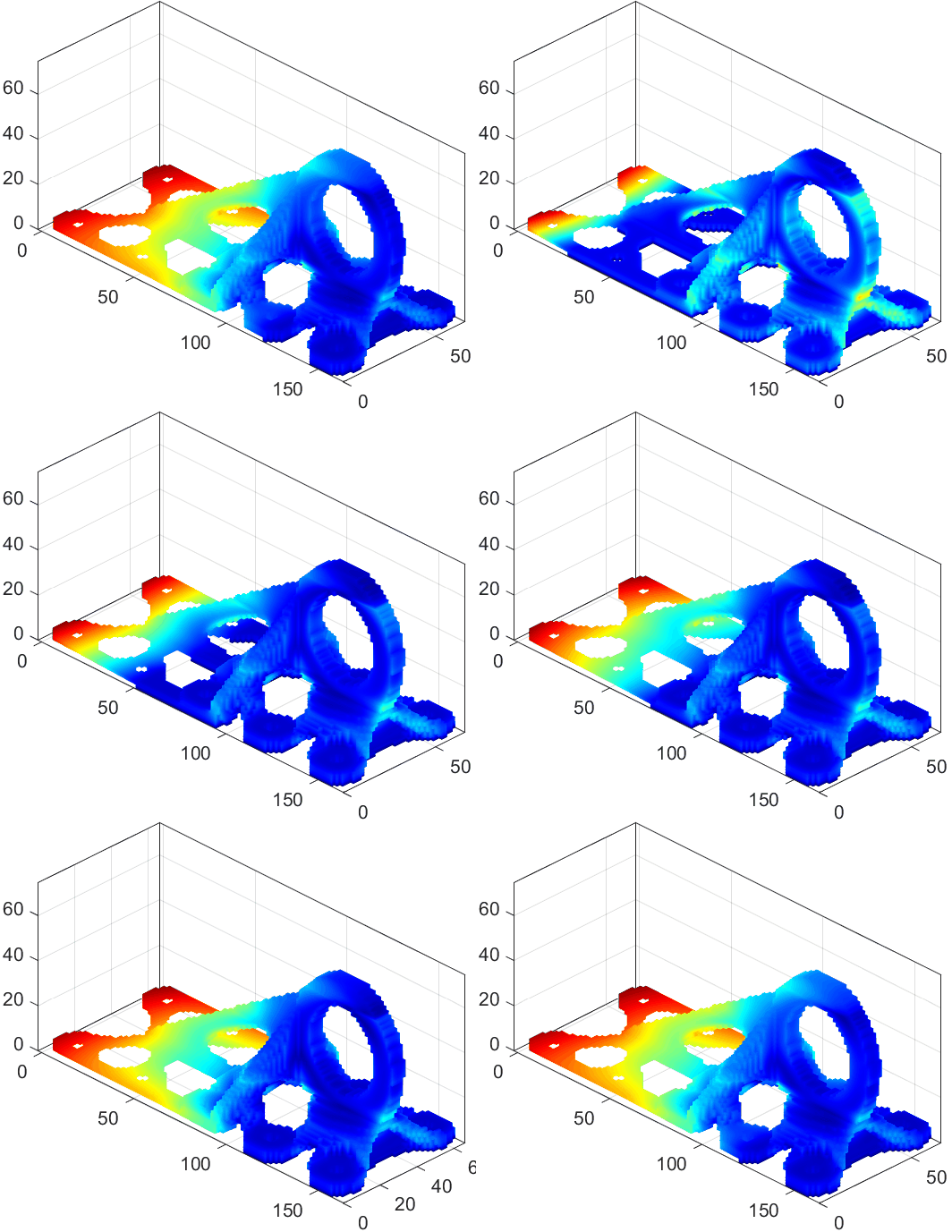
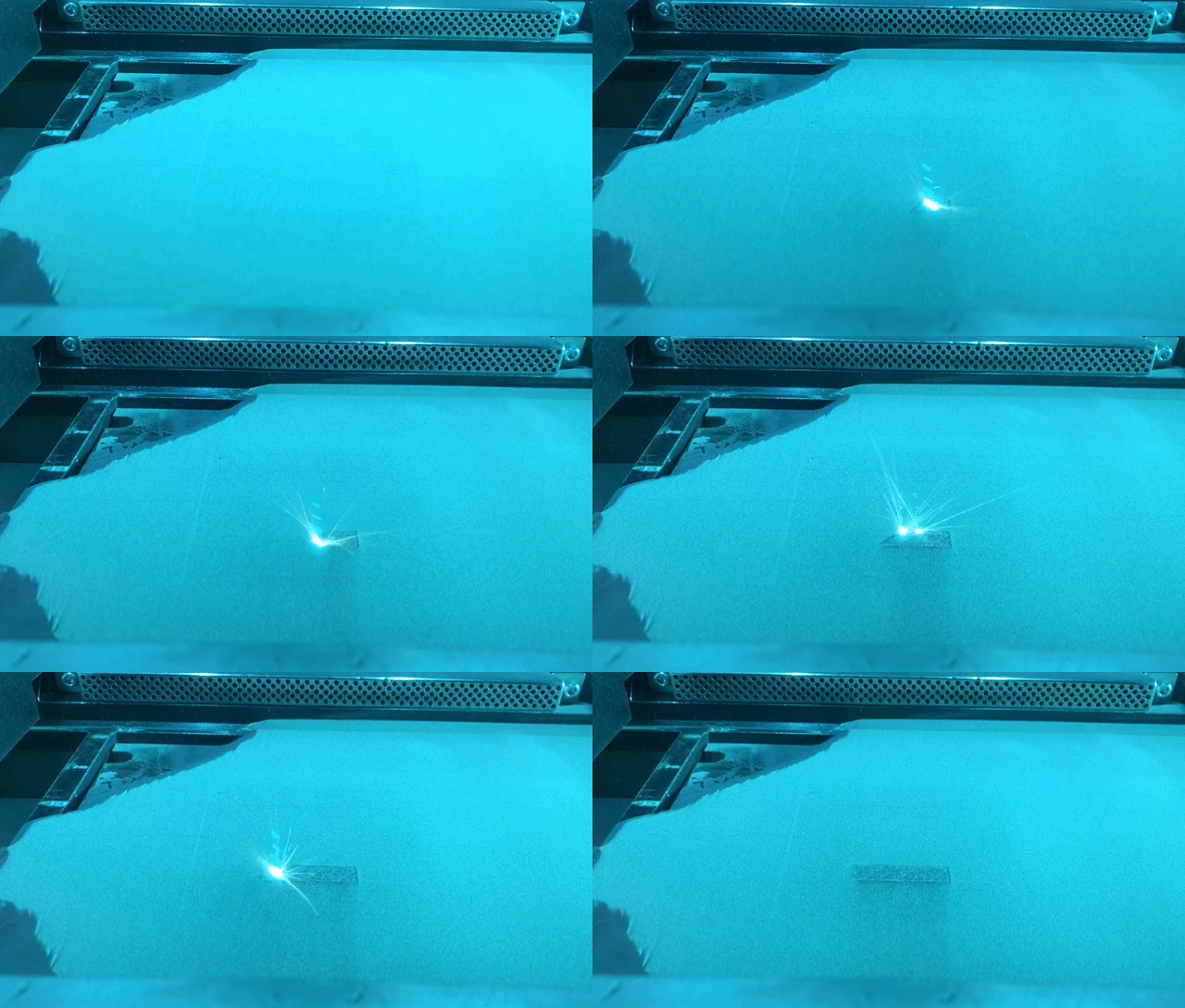
Simulation process: (left) Fusion process; (right) Cut-off process.
2.3.3.Results validation
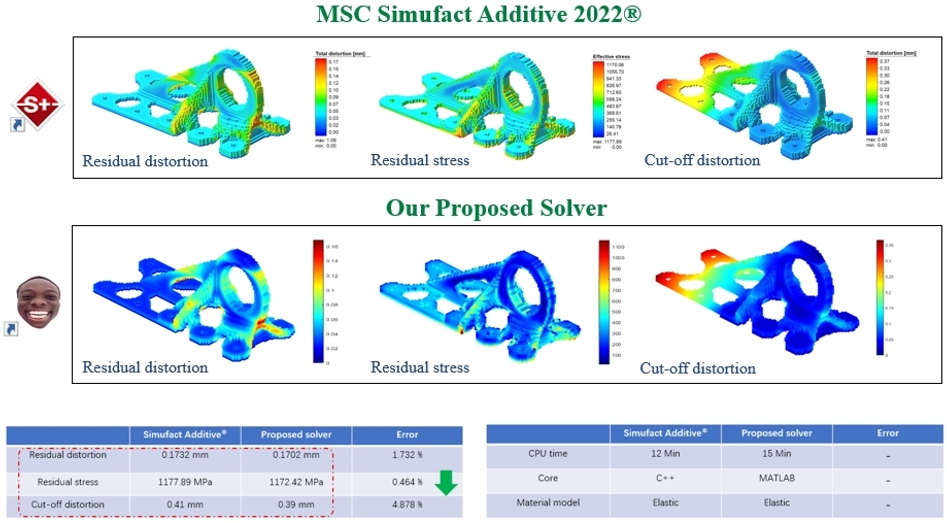
Comparison with commercial software shows errors < 5%, demonstrating solver reliability.
3. Design Optimization based on Inherent Strain Method
3.1. Residual Stress Constrained Structure Topology Optimization

Comparison and verification with commercial software results.
3.2. Scanning Path Optimization for Residual Distortion Reduction
Since it is quite easy to set or adjust such island scanning path of the laser for the metal AM machine, a systemic metal AM-oriented island-type scanning pattern optimization method is therefore proposed in this work.
3.2.1. Problem Definition
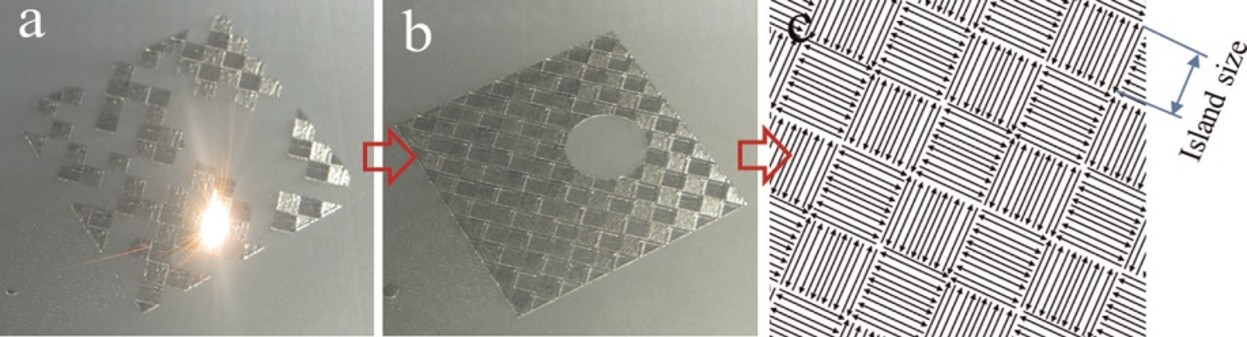
The illustration of scanning island.
3.2.2. Modeling
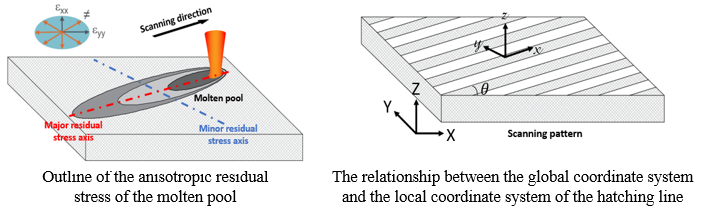
The anisotropic property of inherent strain and modeling.
3.2.3. Optimization Framework
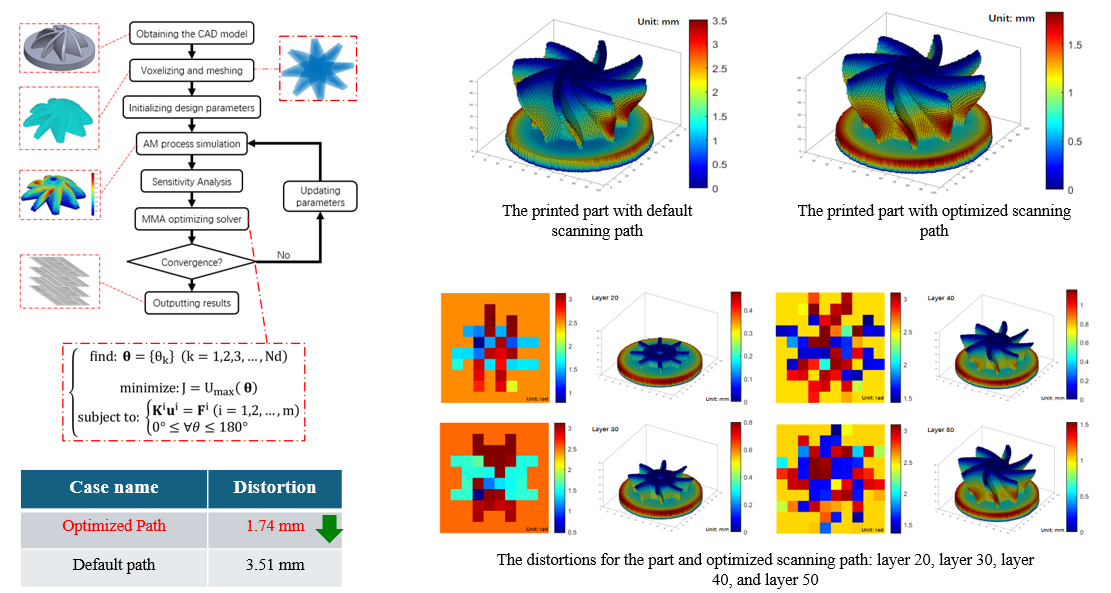
Design framework and case study.
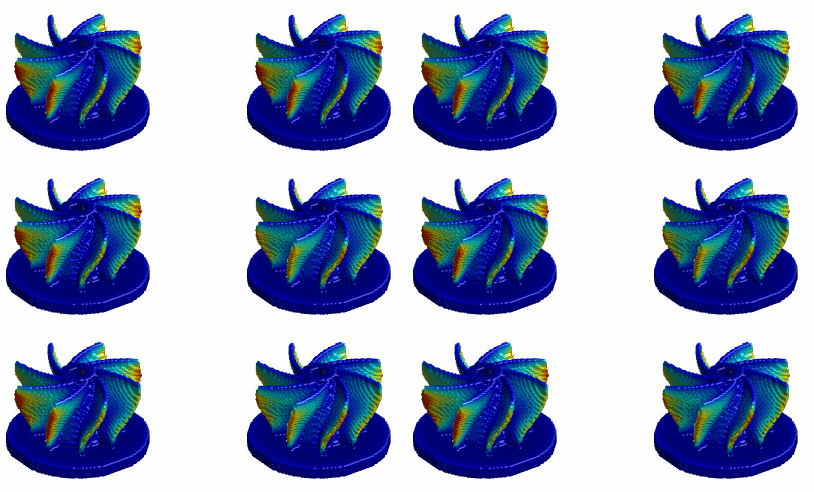
Design framework and case study.
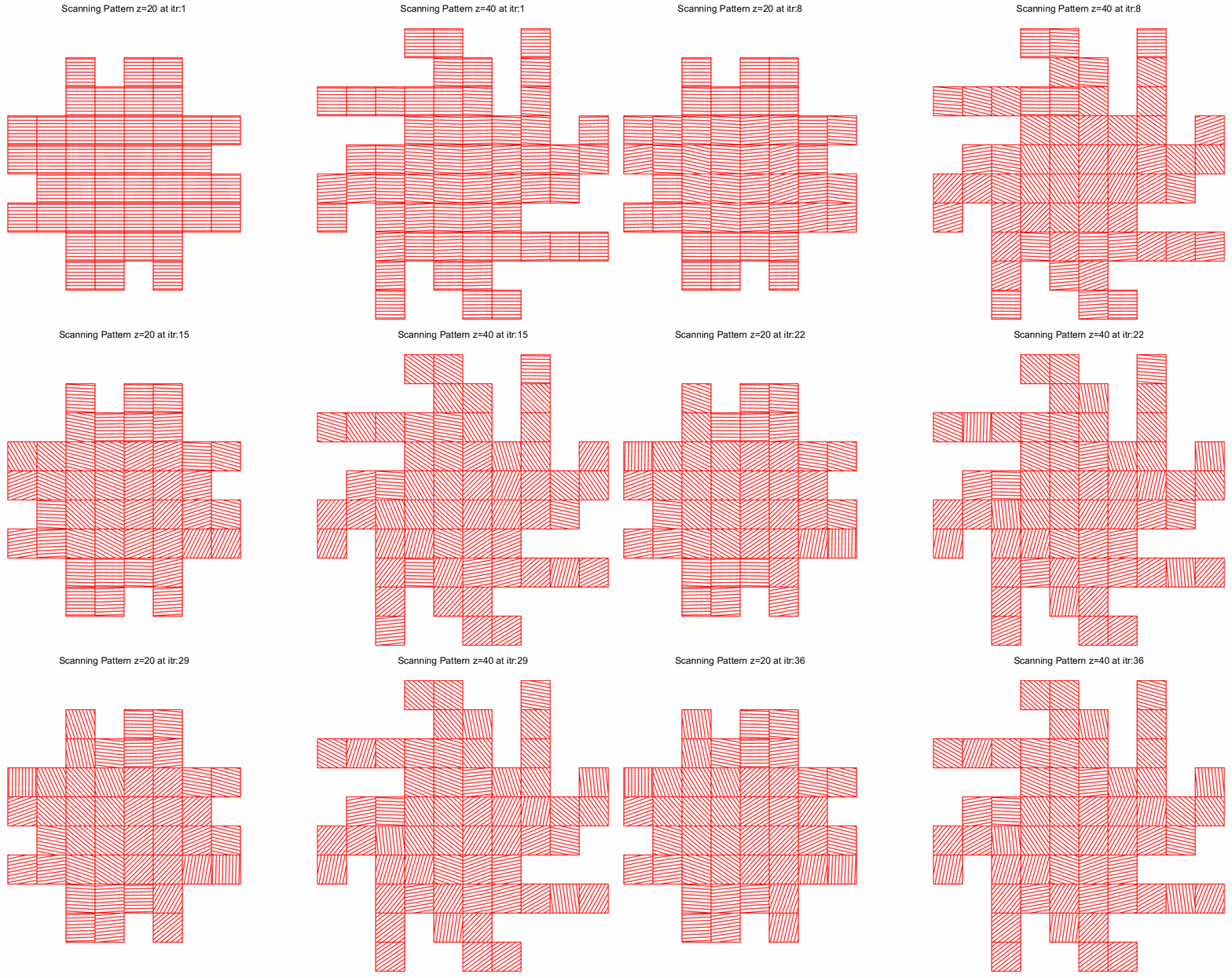
Design framework and case study.
3.2.4. Related Publication
[1] Xu, S., Huang, J., Liu, J., Ma, Y., & Liu, J. (2022). An Island Scanning Path-Pattern Optimization for Metal Additive Manufacturing Based on Inherent Strain Method. Computer-Aided Design and Applications, 19(4), 812-824. [Paper]
[2] Xu, S., Huang, J., Liu, J., & Ma, Y. (2021). Island Scanning Path-Patten Optimization for Residual Distortion Control in Metal Additive Manufacturing. Proceedings of CAD’21, Barcelona, Spain, July 5–7, 2021, pp. 66–72. [Paper]
3.3. Concurrent Structure and Path Optimization for Residual Distortion Reduction
3.3.1. Optimization Framework
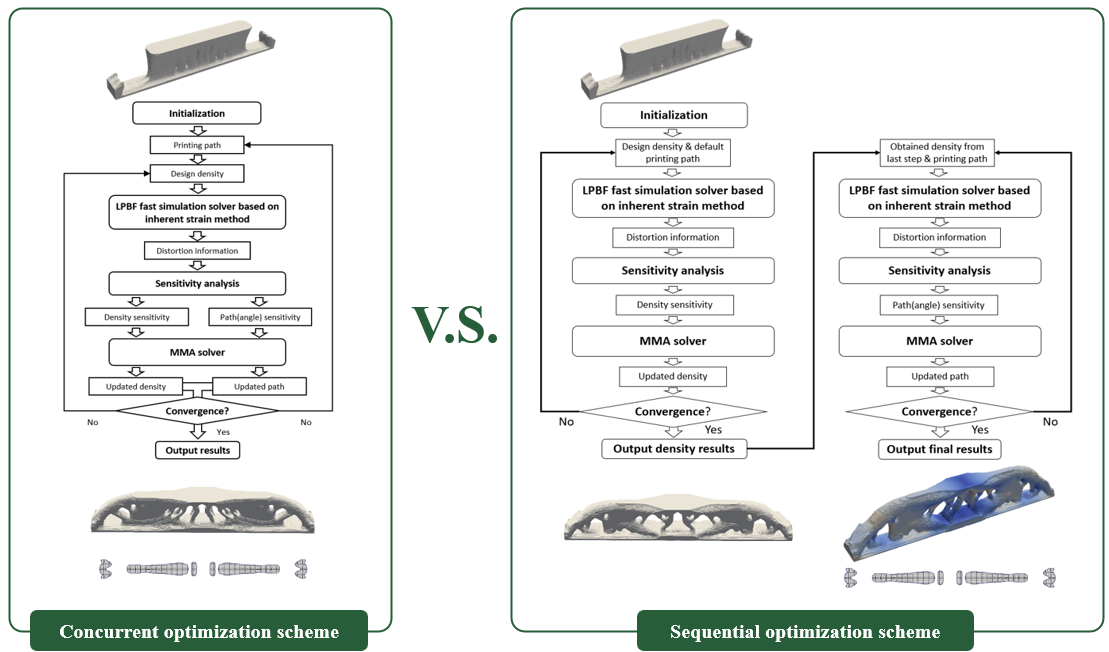
Design framework and case study.
3.3.2. Optimization Results
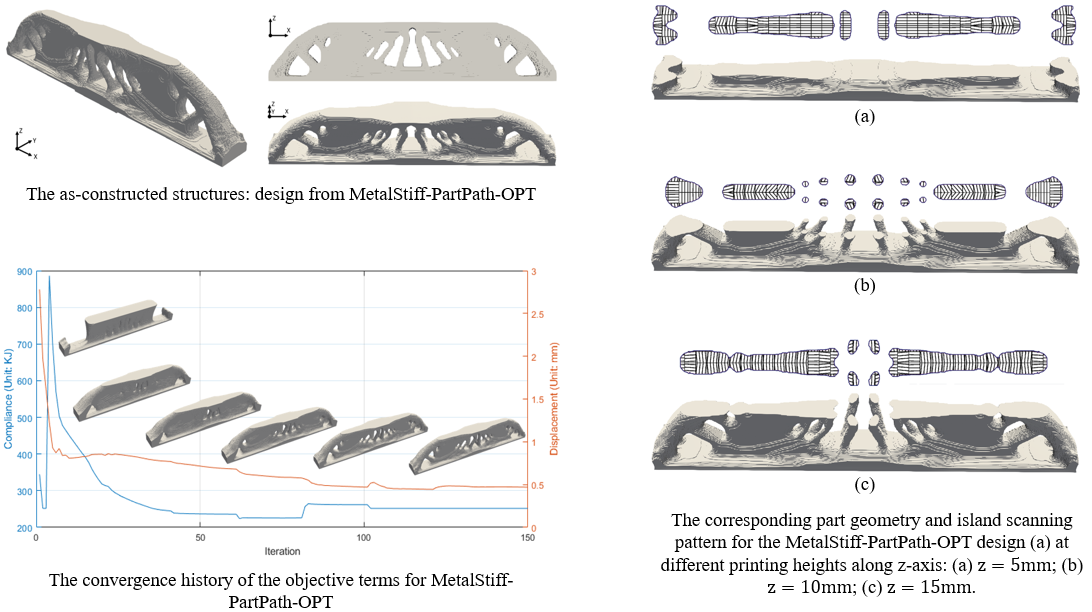
Design framework and case study.
3.3.3. Related Publication
Xu, S., Liu, J., Li, X., & Ma, Y. (2023). Concurrent Island scanning pattern and large-scale topology optimization method for laser powder bed fusion processed parts. Finite Elements in Analysis and Design, 225, 104018.[Paper]
3.4. Support Structure Design for LPBF
3.4.1. Optimization results
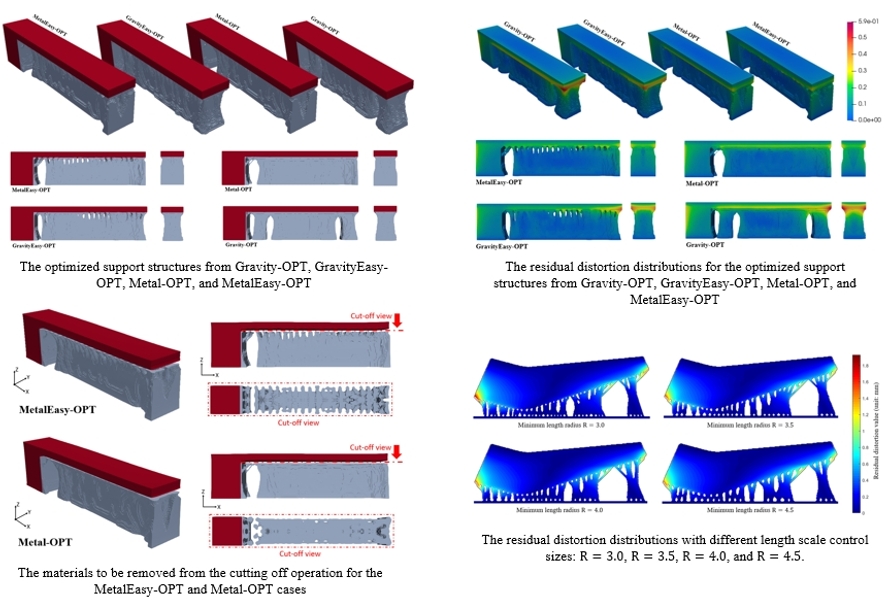
Comparison and verification with commercial software results.
3.4.2. Related Publication
Xu, S., Liu, J., Sun, Y., Li, X., & Ma, Y. (2024). Support structure topology optimization considering the residual distortion for laser powder bed fusion metal additive manufacturing. Structural and Multidisciplinary Optimization, 67(10), 1–20. [Paper]